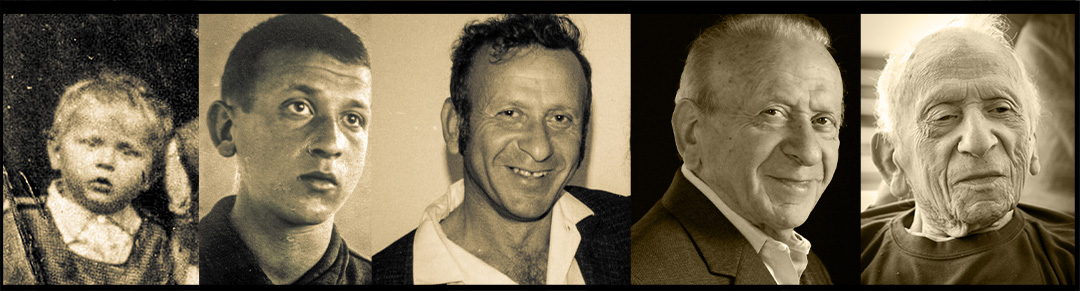
My father’s mother, Yehudit, died a day after he was born in 1928, and so he was orphaned at birth. His only inheritance was his name, Yehuda. At the time, some said he shouldn’t have been born, and the universe for its part, never got around to welcoming him.
His father, Shalom, ran a one-room grocery store in the small village of Moisei in northern Romania. He was among a dozen Jewish families who settled in among the gentile farmers to an uneasy coexistence. Shalom sunk into a deep depression after his wife died. My father was abandoned when his father married a widow who arrived with her own small children. Before his third birthday, his childless uncle and aunt took pity and took him in. Shortly thereafter, they conceived their own daughter. Around his sixth birthday, she told him that his aunt and uncle were not his real parents.
He escaped the tentative and complex adult world to the nearby forests and fields where he spent most of his days and an occasional night. He foraged for food and found peace in the tranquil nature that surrounded him. After some time, the adults decided that he must attend the Heder, a one-room Jewish school. His encounter with schooling was marred by students who bullied him, the gentiles' kids who ambushed and beat him and the teacher who sexually abused him. He tried to appease the schoolboys by giving them candy he stole from his father’s store, but that led to even more severe beatings by his father.
Yet despite a troubled and spotty school attendance, he developed a life-long love of learning sustained by an insatiable curiosity and wonder. He heard that the newly installed telephone wires transmitted voice conversations and spent hours with his ears pressed to the telephone poles trying to listen in.
When he turned eleven, World War II started and everything changed. Jews fleeing the Nazis began to drift through the village. By then he was a master at sneaking in and out of the shadows, and he sat by the window and heard the discussions that ensued after the village leaders listened to the refugees' harrowing stories. The community’s Rabbi insisted that everyone should stay in the village. He assured them that with God’s help this Pogrom too shall pass.
It didn’t. Eleven months later, northern Romania was transferred to Hungary and they started the systematic expulsion of Jews to the death camps in the north. It took a year for the Hungarians to get to the small village of Moisei and send the Jews to a nearby ghetto. It was there that my father’s skills of fearlessly avoiding capture and beatings came to full fruition. At fifteen, with his blond hair and blue eyes, he didn’t look particularly Jewish, and he managed to sneak through the barbed wire fence to bring food and medicine back to the families crowded in the small ghetto. As the caretaker of many people, his social status among his fellow Jews changed and his life acquired a singular purpose, to help as many people as he could.
In the late summer of 1944, everyone in the ghetto was loaded into cattle cars for the transport to Auschwitz that took several days. When the doors finally opened to the cold night with blinding lights and barking dogs, they entered a new world. I learned later that the reason my father could not listen to an opera was that it reminded him of the screaming women as they were separated from their husbands and children. Most of the adults were murdered within a day of arriving at Auschwitz, but the children were sent to special barracks and the young adults to segregated work camps. Within a couple of days, my father managed to sneak out of the children’s barracks, steal some bread and throw it over the fence to his older sister who he spotted housed in the nearby segregated barracks.
He also befriended older French Jews whose job was to tattoo the arms of the working inmates. They allowed him to sleep in their barracks under their bed in return for doing their chores and laundering their clothes. Although he didn’t speak their language, they admired his fearless spirit and explained through gestures the basics of their new tentative existence. The smell of the crematoriums was everywhere, and while he couldn’t fully comprehend the brutal nature of his new reality, he relied on his instincts and on skills honed in his childhood.
Since no parents were left to care for the young children, he adopted his ten-year-old cousin Shmulke, a sickly boy who was imprisoned in the boys' barracks. Every night he stole through the shadows and brought him an extra bread ration. One evening, word spread through the camps that it was Yom Kippur eve. He cleaned up and started the traditional prayers. He was met by sad glances of the French Jews who sat on their bunks and ate their supper. That Jews would eat on the holiest of holidays reserved for fasting stunned him almost as much as the crematoriums. He fasted and anxiously awaited the darkness to give his daily bread ration to Shmulke.
When darkness fell he snuck into the boys’ barracks to find them empty. The Nazi’s picked this special day to murder all the boys in the barracks. The cruelty of the Nazis and the deafening silence of God would reverberate in his mind for the rest of his life. The French Jews did what they could to console him, but he fell sick with sorrow and contracted mumps. They decided to tattoo his arm with a made up number and send him to the camp's infirmary where the infamous Dr. Mengele reined. The number on his arm suggested that he was older and capable of work, and the Nazis with their methodical madness, allowed him to recover so he could be sent back to the work camps until he was fully spent. When his fever broke, he stole out of the infirmary. The French Jews found him a bunk in the laborers' barracks so he could go to work to avoid capture. Every dark dawn, he stood on his tip toes in a long line of inmates with his arm outstretched so they could inspect his tattooed number before being driven to an underground munitions’ factory. There, in stifling heat and deafening noise, he operated a large hydraulic press. In complete exhaustion, he surrendered to this routine for months on end.
As the war drew to an end, the Allies bombed the factory. A refrigerator size bomb landed within a few meters of him and yet failed to explode. It buried him in the mud where he laid unconscious until someone dug him up. With the factory destroyed, the inmates were taken to a nearby town and ordered to help clear the rubble the Allies left behind. After working for several days without food, he turned to two German women walking home with grocery baskets and asked in broken German for some food. They turned away and complained to the German soldier overseeing the inmates who proceeded to beat my father until he lost consciousness.
He woke up in a Swedish hospital some weeks later with no memory of the intervening period. He saw through the window an apple tree in the courtyard. Barely able to move, he waited until night and snuck out to pick apples and hide them under his blanket. The doctors and nurse who came to check on his bruised body in the morning pulled the blanket and looked with amazement at the apples. They murmured among themselves in a language he didn’t understand, but they didn’t touch his apples. It was then that he sensed that the war must be over.
Weeks later he found his older sister’s name on a list of dispossessed people posted in the hospital and found her in a nearby hospital. His hope was rekindled. After a short period of recuperation, they crowded with hundreds of survivors onto a small converted fishing boat that was to take them from Sweden to the promised land of Israel.
As they sailed around Spain, they encountered a storm with 30 feet high waves. Everyone including the crew got sick, and the boat bounced rudderless in the storm with each wave washing over her threatening to drown all aboard. The Israeli captain of the ship whom we met in Tel Aviv decades later, told us that my father tied a rope around this waist and braved onto the wave swept deck to secure the large drinking water barrels that had broken loose in the storm and nearly sunk the vessel. Miraculously the storm passed and the boat remained afloat. As it sailed toward Israel the British intercepted it and diverted it to Cyprus. The survivors from the Nazi camps were once again interned in camps on the sun swept island.
Months later they escaped the British camps and finally made it to Israel. In the excitement and confusion of the clandestine landing, my father couldn’t remember his last name. The Israeli officer who was issuing identity cards to a long line of refugees asked him for his father’s name instead. And thus my father came to be known as Yehuda Ben-Shalom. He entered Israel adorned by the only thing he had left - the names of his parents, Yehuda son of Shalom.
A day later he was sent to help defend a kibbutz in the south. He was immediately put to work digging entrenchments around the kibbutz during the day and serving as a cook and a baker in the evenings. Israel’s Independence War broke out a few months later. He and two dozen young men and women with a few guns, one mortar tube, and a few precious shells managed to hold off the well-equipped Egyptian army that was determined to overrun their kibbutz. My father was 20 when the State of Israel was born, and with its birth, he was determined to rebuild his life.
While holding two jobs, he managed to get his high school equivalency diploma. He enrolled in the agricultural school and worked as a school inspector. While visiting a classroom in 1956 on an inspection tour, he met my mother, Hana. Their brief courting period ended with a marriage proposal. It was brokered by his older sister who convinced Hana’s observant parents that despite his blond hair, blue eyes and secular appearance, he came from a good Jewish home.
I was born 10 months later, but in the interim, he managed to lead an artillery unit during the Sinai war. This time he went into battle with many more mortar tubes and ammunition.
My mother’s new name Hana Ben-Shalom, with its male gender surname, became a topic of bemused conversation among her young students. So she decided to borrow the N from Ben and graft it onto Shalom and gave birth to our surname - Shalon. My brothers were born four and eight years later. My parents named each of us after a tree to memorialize the rebirth of a generation cut down in its prime.
Despite not having finished grade school, my father taught himself English and enrolled in the chemistry department of Hebrew University in Jerusalem where he earned a Masters degree and eventually a Ph.D. in medicinal chemistry.
When I was ten, he was drafted back to his artillery unit days before the 1967 war broke. Dressed in his army fatigues and after hugging and kissing everyone, he asked me to walk with him outside. He asked me to ensure that if he doesn’t return, his body should be cremated and not buried according to Jewish custom in a religious funeral. Years later, I understood that he had one more issue to settle with God.
In 1970 my parents immigrated to the US when my father accepted a post-doctoral position in Massachusetts followed by another in St. Louis and then followed by a few years of employment at Sigma Chemicals. He left Sigma in his early 50’s to do that most American thing, to start his own business. HT Chemicals sold bio-chemicals purified using high-pressure liquid chromatography. Subsequently, he renamed the company to ModCOL and began to sell the equipment he invented to improve this purification process. He sold the business a couple of decades later.
He moved with my mother from St. Louis to Palo Alto when he turned 70 and lived a few blocks from us. He came to our house for dinner every night and helped us raise our children who adored him. When he was 84, my mother died after a long illness which kept her bed-ridden for nearly three decades. With her death, his memory began to slip. He always wanted to go back to live in Israel, and fearing time was working against fulfilling this dream, we helped him move back to Jerusalem when he was 85. He lived with a caretaker in an apartment overlooking the old city not far from where his artillery unit was stationed during the 1967 War when he helped liberate Jerusalem.
Along the way, he managed to beat a heart attack with a quadruple bypass and two cancers. The last one encountered when he was 86 when it didn’t seem likely that he could escape its clutches. Just before he turned 90, he moved back to Palo Alto.
Despite the world's best efforts to kill him, he survived, married, earned a doctorate, raised three sons, created a successful business, and lived to old age. It is said that the secret to a long life is kindness, and to eternal youth is curiosity. Somehow he discovered these truths and shared them with everyone without using words. Throughout his long journey, everyone who met my father was touched, changed and never forgot the encounter. A short, kind man, he was universally loved by all who knew him. And yet, he seemed genuinely surprised that anyone cared or loved him, this was one thing he never learned to take for granted.
After abandoning a god who abandoned him, he adopted the religion of kindness instead, maybe because he found it to be most valuable and scarce in his world. In the end, he forgave everyone except himself. With tears in his eyes, he told me that he could not forgive himself for not being able to save Shmulke from the claws of the Nazi beast that devoured him.